Serene Forest

Showing posts with label triggers. Show all posts

Wednesday, June 24, 2015

Identify And Eliminate The Triggers Of Periodic Paralysis: Part Two

Hello All,

As I wrote in Part One, nearly everyday, new members join our PPN Support, Education and Advocacy Group. Their most important concerns are about getting treatment to stop or manage their symptoms/paralysis and/or getting a diagnosis. I have already written articles about how to find a good doctor and how to get a diagnosis, which may take many years, but to this point have not written about how to identify and eliminate the triggers that set off our symptoms and paralysis.

As I have written before, there is no magic drug or cure for Periodic Paralysis. There is an off-label drug that only works for a few mutations and even then, there are and can be, serious side effects, long term side effects and most individuals continue to experience paralysis and symptoms. So despite having a diagnosis and possibly taking the off-label drug, most individuals need to know how to manage their symptoms and episodes of paralysis, because most triggers continue to set these things into motion.

For those still waiting for a diagnosis and hoping for drugs/treatment from a “specialist” the diagnosis will probably not bring a successful treatment. So, while waiting for a diagnosis, or if one has a diagnosis and is on the off-label drug and still experiencing symptoms or if someone has a diagnosis but cannot tolerate the off-label drug; the best way to manage the symptoms and paralytic episodes to is identify the causes or triggers for those symptoms and episodes.

This is part two of a Blog Article about how to identify and eliminate triggers.

From our book: The Periodic Paralysis Guide and Workbook:

Identify And Eliminate Triggers
AVOID - CHART - JOURNAL - MONITOR


  • Record symptoms and possible causes
  • Monitor symptoms
  • Keep a journal
The charts and how to use them:


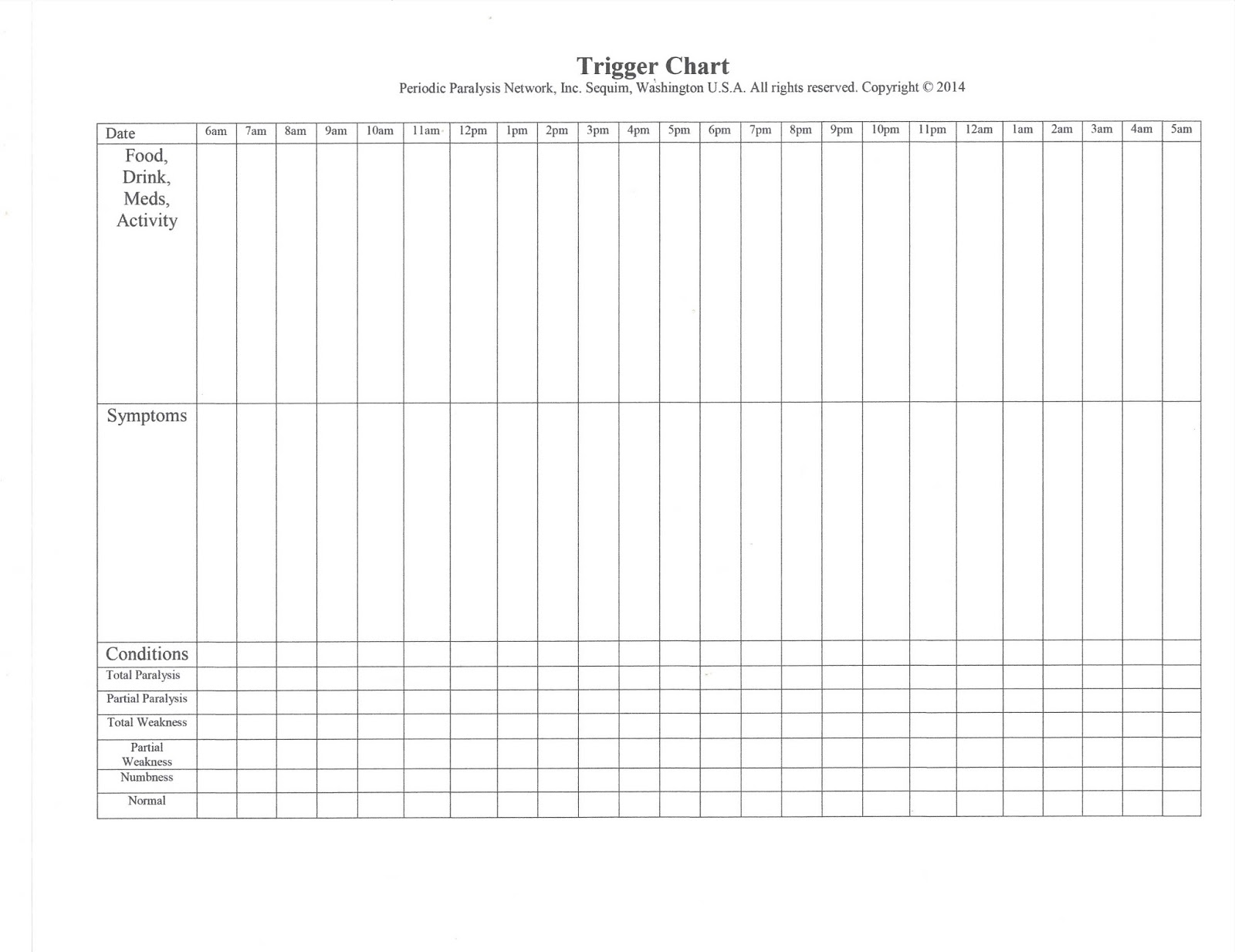
Trigger Chart

Fill in the date.

  • Begin recording your activities, food, drink and medications in the top section. Start at the time you wake up. Include all food eaten in a meal. Record what you are doing, for instance sitting, eating, reading, exercising, walking, cooking, shopping or more.
  • Record how you are feeling, for instance, good, very thirsty, constipated, confusion, sleepy, unsteady, legs are weak, total paralysis or more.
  • Put a check mark in, (or fill in) the box that best describes your condition, for instance normal, weak, more weak, partial paralysis, more partial paralysis, or total paralysis.
  • Continue this through your day, it is not necessary to do it at night, but you may want to include paralysis, numbness, or more, if it is happening at night.
  • The bottom of the chart will become a graph and it will aid in seeing the times of symptoms.

In the completed chart below, we can see that two and one half to three hours after eating breakfast and taking septra, an antibiotic and a calcium tablet, the patient begins to experience weakness and then paralysis. It is a good chance that the medication or something eaten at breakfast was the cause.

If this person eats the same thing everyday and takes the calcium every morning, and the only new thing is the septra it would be safe to assume the antibiotic caused the episode. By four pm the episode has stopped. At five pm muscle weakness begins after an hour of being up and preparing dinner. This may be from exercise intolerance or due to something eaten at lunch.

If someone eats the same lunch everyday but does not always help with dinner, it could be safe to assume the exercise caused the weakness. The same could be true in reverse. At seven pm, overall weakness takes hold for the remainder of the evening. This may be from the food eaten at dinner or a continuation of the weakness from the earlier activity. During the night there are three episodes of total paralysis. Since sleep is a trigger, it may be impossible to stop the episodes throughout the night.


Evaluating the Data

When looking at your completed charts, it is best to first check the periods of paralysis. Then check the activity, medications taken or food eaten two to three hours before that time. Was anything new? Was any activity out of the ordinary?

  • Check period of paralysis or weakness:
    • Check two to three hours before.
      • New medication?
      • New food, drink?
      • New activity?
        • More than usual?
        • Longer than usual?
  • If answer is not clear: Continue to chart for a few days. If there seems to be a pattern:
    • Change only one thing at that time:
      • Remove sugar or
      • Cut medication dose or
      • Stop or reduce the activity
        • Less than usual
        • Shorter than usual
  • Check again after a day or two. If the symptoms of paralysis are reduced or better, you may have found the trigger. If not, add the thing you removed or reduced back into the meal, etc. Then repeat and change something else: 
  • Change only one thing at that time:
    • Remove sugar or
    • Cut medication dose or
    • Stop or reduce the activity
      • Less than usual
      • Shorter than usual
  • Repeat until you find the trigger or triggers.

Some suggestions for how to avoid the triggers once they are found:

  • On feet too long? : Break the activity in several shorter periods on feet.
  • Cannot eat sugar? : Stop and try sweeteners, honey, stevia, etc.
  • Cannot eat certain food? : Find replacement or do without.
  • Cannot take medication? : Cut dosage, stop taking or get a replacement (under supervision of medical professional).
  • Sitting too long? : Get up every hour or less and move around.
  • Sitting too long? : Exercise in chair.
  • Dehydrated? : Drink more water, set timer.
  • Hungry? : Eat several smaller meals.
  • Too hot? : Wear looser, cooler clothes, use neck cooler.
  • Too cold? : Add clothing layers, use a blanket, drink hot drinks.
  • Cannot drink caffeine: Drink decaffeinated drinks.

As the triggers are discovered and eliminated the attacks of paralysis and other associated symptoms will begin to decline. The quality of life will improve. The information will be recorded and can be shared with the doctors and used as a tool during the diagnosing process. Use the following blank page to record your own triggers as you discover them.


Monitoring the Triggers and Symptoms

Once many of the triggers have been established and a diagnosis has been obtained (or not), it will be necessary to continue to observe and monitor the symptoms and the triggers. As we have discovered from my our experience and that of others with Periodic Paralysis, the triggers may change over time or what may have seemed to be the cause, may not actually be the cause. It is important to keep track continually in order to regulate and control the symptoms.

For instance, at first it may appear that sugar eaten in a cookie is the culprit causing attacks of muscle weakness or paralysis. Later it may be discovered that it was actually the white flour or the chocolate in a cookie that may have caused the episode. Accidentally, it may be figured out that a person might be able to eat small amounts of sugar in a gluten-free cookie. Then after eating the gluten free cookie everyday for three days, a paralytic episode occurs. This may be that too much was eaten. So, it may be that small amounts of sugar may be eaten occasionally, just not everyday.

It is a fine line that an individual with Periodic Paralysis must walk everyday. We must move through life as if we are walking a tightrope. It has been said that when we figure out what our triggers are, we must treat them as if they are allergies, something we must avoid. However, it becomes a problem when those things are important elements needed in the body such as salt or sugar.

In discussion with other individuals, we also have discovered that surprising things may actually cause an attack. We may believe we are doing everything correctly and avoiding all triggers and then we suddenly slip into full body paralysis. This happened to me recently. I tripped on my oxygen cord and landed on my knees. I scraped up one of them, but otherwise felt fine. Three hours later I was in full body paralysis.

After discussing this with a friend and wondering what had caused this attack, he reminded me that adrenaline is released when the body is stressed or experiences some trauma. I realized that although I did not notice much when I fell except a small scrape to my knee, my body had recognized it as trauma, released adrenaline and three hours later I was paralyzed and for the following several days.

Now I will remember that if I fall again, no matter how small or uneventful it may seem, I must prepare for the possibility of slipping into paralysis. I will be sure to rest and hope it will neither happen again nor be as serious as the last time. Better yet, I need to be more careful, now that I know if I fall, I will go into paralysis (or break a bone knowing I have severe osteoporosis).

Monitoring or keeping track of triggers is important because it seems as if they are always changing and maybe they are or maybe it is the amount of something we are using, but also it may be that we have misinterpreted one trigger for another. We must use the charts to keep track of symptoms and possible triggers and put them together in a journal. The information in the charts and journal will be recorded and can be shared with the doctors and used as a tool during the diagnosing process or for treatment options.


Until later...


Identify And Eliminate The Triggers Of Periodic Paralysis: Part One


Hello All,

Nearly everyday, new members join our PPN Support, Education and Advocacy Group. Their most important concerns are about getting treatment to stop or manage their symptoms/paralysis and/or getting a diagnosis. I have already written articles about how to find a good doctor and how to get a diagnosis, which may take many years, but to this point have not written about how to identify and eliminate the triggers that set off our symptoms and paralysis.

As I have written previously, there is no magic drug or cure for Periodic Paralysis. There is a type of drug that only works for a few mutations and even then, there are and can be, serious side effects, long term side effects and most individuals continue to experience paralysis and symptoms. So despite having a diagnosis and possibly taking the drug, most individuals need to know how to manage their symptoms and episodes of paralysis, because most triggers continue to set these things into motion.

For those still waiting for a diagnosis and hoping for drugs/treatment from a “specialist” the diagnosis will probably not bring a successful treatment. So, while waiting for a diagnosis, or if one has a diagnosis and is on the off-label drug and still experiencing symptoms or if someone has a diagnosis but cannot tolerate the off-label drug; the best way to manage the symptoms and paralytic episodes to is identify the causes or triggers for those symptoms and episodes.

This is part one of a Blog Article about how to identify and eliminate triggers.


From our book: The Periodic Paralysis Guide and Workbook:


Identify And Eliminate Triggers
AVOID - CHART - JOURNAL - MONITOR

  • Record symptoms and possible causes
  • Monitor symptoms
  • Keep a journal

This Blog Article...will discuss the elements or experiences, which trigger or activate the potassium to shift causing the attacks of periodic paralysis and how to identify them. There are some common triggers among those with the different forms of Periodic Paralysis and there are some triggers, which are unique for each individual. Triggers can be certain medications, foods, activities, stress or even sleep. It is important to know one’s triggers in order to avoid having episodes or attacks of paralysis due to permanent damage, which may occur to organs in the body.

One of the most important things a person with Periodic Paralysis can do, no matter which type they have, is to discover what causes, starts or triggers our episodes of muscle weakness or paralysis. There are many triggers that set into motion the partial and total paralysis and other symptoms. It is important to discover these triggers because we need to stop the episodes or attacks, if possible, in order to regain the quality of our lives and to prevent the damage being done to our organs as the potassium shifts and depletes or increases in our bodies.

Potassium shifting can cause a myriad of conditions and the symptoms that accompany them, including permanent tightness of the calf muscles or muscle wasting of arm and leg muscles, restless leg syndrome or even osteoporosis. The breathing and swallowing muscles can weaken over time and be affected during attacks. If this happens it is an extremely serious and emergency situation. Dangerous arrhythmia of the heart can also occur when an individual is in an episode or attack. In the case of people with Andersen-Tawil Syndrome, the paralysis leads to tachycardia and serious arrhythmia, including long QT intervals, which can lead to cardiac arrest. Other complications can include respiratory arrest causing death or aspiration pneumonia after an attack, causing death. Though rare, these can occur with Hypokalemic Periodic Paralysis. Complications of Hyperkalemic Periodic Paralysis include bi-directional heart arrhythmia causing sudden death and permanent weakness of the muscles. Between attacks, the muscles usually return to normal or strengthen, but over time with repeated episodes of paralysis, progressive and permanent weakness of the muscles which can be severe is possible. This includes the heart and breathing muscles. This can lead to heart failure and respiratory failure, thus eventual death. Avoiding paralysis is absolutely necessary, due to these life-threatening effects.

The easiest way to decide what caused an episode or symptoms would be to look at anything new or different; a new type of bread, a new antibiotic, a new activity, a new shampoo, stressful event (good or bad), or a chilled or over heated room. Discovering our triggers requires a little bit of time to follow a simple plan. In a matter of a few days or weeks, it may be possible to draw some useful conclusions about the possible triggers of a paralytic event and the symptom, which can accompany them.

In the fields of medicine and education, it is said, “If you did not write it down, it did not happen.” This can be applied to our method for discovering our triggers. The first thing we must do is to write everything down. Creating a journal is a good way to make sure this is done. I have created a chart, which can be added to a journal to make the process easier (This will be added to part two of this article).

Several necessary components are included on this chart:

A 24-hour time frame
A section to write possible triggers
A section to write down symptoms and vitals one may be experiencing
A section to record the muscle weakness and paralysis
This section becomes a graph of the periods of weakness or paralysis

Once the information has been gathered for a few weeks, it will be easy to see trends or connections of a particular food, medication or activity to muscle weakness or paralysis.

The following are lists of the common possible symptoms of Periodic Paralysis one may experience as well as the paralysis and muscle weakness and the triggers, which may set them into motion.

Understanding and becoming familiar with the symptoms is another important part of completing the chart. As much information that can be added will be helpful. In this section anything may be included from “feeling well,” or “none,” to some of the known symptoms for hyperkalemia and hypokalemia in the following charts.

The following are at-a-glance lists of typical symptoms and triggers for the different forms of Periodic Paralysis and vitals needed to complete the charts.

The Symptoms Typical Of Low Potassium:

  • Episodic muscle weakness
  • Episodic partial paralysis
  • Episodic total paralysis
  • Episodic flaccid paralysis (limp muscles, without tone)
  • Muscle weakness after exercise
  • Muscle weakness
  • Muscle stiffness
  • Muscle aches
  • Muscle cramps
  • Muscle contractions
  • Muscle spasms
  • Muscle tenderness
  • Pins and needles sensation
  • Eyelid myotonia (cannot open eyelid after opening and then closing them)
  • Irritability
  • Severe thirst
  • Abdominal bloating
  • Nausea
  • Vomiting
  • Constipation
  • Excessive urination
  • Sweating
  • Tachycardia
  • Irregular heartbeat
  • Palpitations
  • Dizziness
  • Fainting
  • Breathing problems (barely breathing)
  • Hypo-ventilation
  • Increase in blood pressure
  • Irritability

Vitals To Add To The Chart As Symptoms:

  • Potassium level
  • pH level (saliva)
  • pH level (urine)
  • Glucose (sugar) level
  • Temperature
  • Blood pressure
  • Heart rate
  • Arrhythmia
  • Oxygen

The Symptoms Typical Of High Potassium:


  • Episodic muscle weakness
  • Episodic partial paralysis
  • Episodic total paralysis
  • Muscle contraction or rigidity during an attack
  • Muscle weakness
  • Muscle cramps
  • Muscle stiffness
  • Fasciculation (muscle twitching)
  • Pins and needles sensation
  • Cramping pain
  • Reduced reflexes
  • Muscle contraction involving tongue
  • Slurring of words
  • Tightness in legs
  • Strange feeling in legs
  • Tingling sensations
  • Pulse issues  (absent, slow, or weak)
  • Irregular heart beat
  • Heart palpitations
  • Breathing problems (wheezing, shortness of breath, fast breathing)
  • Mild hyperventilation
  • Decrease in blood pressure 
  •  Nausea
  • Feeling hot
  • Sleepiness  

More Possible Symptoms For The Chart:
 
  • Headache
  • Chest pain
  • Numbness
  • Unable to walk
  • Agitation
  • Shallow breathing
  • Pain in calves
  • Cramps in legs
  • Restless legs
  • Burning in feet
  • Hyperventilation
  • Feeling cold
  • Clammy
  • Dizzy
  • Shaky
  • Unsteady
  • Rubbery legs
  • Hunger
  • Jerking
  • Awake
  • Confusion
  • Strange feeling in legs
  • Brain fog
  • Sleeplessness
  • Memory problem
  • Depression
  • Weakness
  • Constipation
  • Foot drop
  • Dry mouth
  • Choking
  • Angry


Triggers
(The following are not "set in stone" and can cross over among the different forms of Periodic Paralysis. These are just as a general rule....)

The Common Triggers Of Hypokalemic Periodic Paralysis

The triggers usually responsible for causing potassium to shift in Hypokalemic Periodic Paralysis are:

  • Eating a large amount of carbohydrates in a meal
  • Eating a meal with too much salt
  • Stress (good or bad)
  • Vigorous exercise
  • Resting after exercise
  • After lengthy periods of inactivity (traveling in a car)
  • Cold
  • Infections
  • Epinephrine/adrenaline
  • Insulin
  • Pregnancy
  • Surgery
  • Anesthesia
  • Glucose (Dextrose) IV
  • Saline (Sodium) IV
  • Steroids

The Common Triggers Of Hyperkalemic Periodic Paralysis

The triggers usually responsible for causing potassium to shift in Hyperkalemic Periodic Paralysis are:

  • Ingesting too much potassium in food, supplements or medications
  • Stress (good or bad)
  • Rest after exercise
  • Fatigue
  • Fasting
  • Possibly low blood sugar 
  • Alcohol
  • Pregnancy
  • Contaminated air such as smoking
  • Weather changes
  • Cholinesterase inhibitors 
  • Depolarizing muscle relaxants

The Common Triggers Of Paramyotonia Congenita

The triggers usually responsible for causing potassium to shift in Paramyotonia Congenita are:

  • Exercise
  • Exertion
  • Repetitious movement
  • Cold
  • Sleeping in
  • Possibly all triggers for Hyperkalemic Periodic Paralysis


Other Triggers For Periodic Paralysis

Triggers can include:

Diet: Diet can be one of the biggest contributors to episodes of paralysis. The following are some of my offenders or those that have been reported to me or I have found in the research:
  • Simple carbohydrates: sugar, white flour and more
  • Complex carbohydrates: some grains, wheat, rye and more
  • Meat: mostly red meats
  • Salt
  • Caffeine
  • MSG
  • Alcohol
  • Large meals
  • Gluten
  • Processed  foods
  • Food dyes
  • Food additives 
  • Meat or dairy products with hormones, and antibiotics
  • Fruits and vegetables with pesticides
  • Drinking water with hormones, antibiotics, pesticides or traces of any drugs (most drinking water, even bottled water)

Sleep:
All aspects of sleep may set episodes into motion:
  • Falling asleep 
  •  During sleep
  • Waking up

Other:
  • Dehydration
  • Fasting
  • Sitting too long
  • Changes in the weather
  • Fatigue
  • Heat
  • Cold
  • Electromagnetic Force (EMF’s)
  • Menstrual cycle
  • Pregnancy
  • Surgery
  • Infections, viruses 
  • Immunizations, vaccinations
  • Sudden or strobing lights, sounds, movements (touch, sound or vision)
  • Chemicals (sensitivity)

Exercise:
Some individuals have no problem with exercise but others may not be able to tolerate any type of exercise or very little exercise. This is called “exercise intolerance.” Episodes may develop soon after or the next day.

Rest after exercise: may set an episode into motion.

Unknown: One can follow all the rules and still have episodes for unknown reasons.

Over-the-counter medications:
Most over the counter medications, can set muscle weakness or paralysis into motion for people with Periodic Paralysis. The following is a list of some known offenders.

  • Eye drops
  • Glycerin enemas
  • NSAID’s
  • Cough syrups 
Compounds or Chemicals:
If the following ingredients are in any products you use…you should stop using them until you are sure they are not causing symptoms:
  • Sodium Hydroxide 
  •  Edetate Disodium
  • Stearic Acid

They may be in any of the following:
Lotions, oils, hair dyes or colors, antiperspirants, enemas, suppositories, soaps, shampoos, shaving creams, foams, toothpastes, deodorants, beauty products, skincare products, cosmetic products, bath salts, emollients, ointments, creams, hair sprays, perfumes, colognes, powders, hair gels, oils, tonics, mousse

Drugs:
Many, many drugs can set muscle weakness or paralysis into motion for people with Periodic Paralysis.

If one must take a drug, it is better to begin with ¼ of a normal dose to make sure it will work for you.

  • Saline drips, glucose infusion: If an IV is needed, mannitol can be used(or diluted solutions in extreme cases) (excluding HyperKPP)
  • Oral or Intravenous Corticosteroids
  • Muscle relaxers
  • Beta blockers
  • Tranquilizers
  • Pain killers (analgesics)
  • Antihistamines (except HyperKPP)
  • Puffers for asthma
  • Antibiotics
  • Cough syrups
  • Eye drops to dilate eyes
  • Contrast dye for MRI’s
  • Lidocaine 
  •  Anesthetics
  • Epinephrine (Can sometimes help symptoms of Hyperkalemic Periodic Paralysis)
  • Adrenaline (Can sometimes help symptoms of Hyperkalemic Periodic Paralysis)

For more information about the medications or drugs which can cause muscle weakness, muscle paralysis, long QT interval hearts beats (ATS) and torsades de pointes (ATS), please go to: 

 What are the Periodic Paralysis Triggers? AVOID AT ALL COST
https://www.periodicparalysisnetwork.com/archives

https://www.openanesthesia.org/hyperkal_periodic_paralysis_triggers/
https://ghr.nlm.nih.gov/condition/hyperkalemic-periodic-paralysis
https://en.wikipedia.org/wiki/Hyperkalemic_periodic_paralysis
http://www.ncbi.nlm.nih.gov/books/NBK1338/
http://www.ncbi.nlm.nih.gov/pmc/articles/PMC3700163/


Until later...

Tuesday, February 4, 2014

What is Periodic Paralysis?


Hello All,

I am re-posting this article in two parts. It was not actually posted on my blog but I have a link to it in another site. There may be issues with the link so I decided to post it again. This article contains the facts about Periodic Paralysis and the other article, "My Story" is the personal narrative of how I got diagnosed.
                                             What is Periodic Paralysis?


One of the neurologists who diagnosed me recently said, “Periodic Paralysis is a disease unlike any other. It is not a neuromuscular, mitochondrial or autoimmune disease nor is it a muscle myopathy. It is in a category all its own and needs to be treated in non-conventional ways.” He further stated, “Doctors need to keep an open mind and think ‘outside of the box’ when it comes to diagnosing and treating Periodic Paralysis.”


The following is an overview of the condition gleaned from years of research and my own experience.


Periodic Paralysis (PP) is an extremely rare, hereditary disease characterized by episodes of muscular weakness or paralysis, a total lack of muscle tone without the loss of sensation while remaining consciousness. It is passed from either the mother or the father to any of the children, male or female. It is a mineral metabolic disorder also known as an ion channelopathy, a disease involving dysfunction of an ion channel for potassium, sodium, chloride or calcium. Ion channels regulate ions as they flow in and out of the cells.


There are several known types:


Hypokalemic Periodic Paralysis (Hypo PP): Paralysis results from potassium moving from the blood into muscle cells in an abnormal way. It is associated with low levels of potassium (hypokalemia) during paralytic episodes.


Hyperkalemic Periodic Paralysis (Hyper PP): Paralysis results from problems with the way the body controls sodium and potassium levels in cells. It is associated with high levels of potassium (hyperkalemia) during paralytic episodes.


Normokalemic Periodic Paralysis (Normo PP): Paralysis results from the movement or shifting of potassium within ranges, which are normal (normokalemia).


Andersen-Tawil Syndrome (ATS): Paralysis results when the channel does not open properly; potassium cannot leave the cell. This disrupts the flow of potassium ions in skeletal and cardiac muscle. During paralytic episodes, ATS can be associated with low potassium, high potassium or shifts in the normal (normokalemia) ranges of potassium. Andersen-Tawil Syndrome is discussed in more detail later in this section.


Only about 50% of the above known types of Periodic Paralysis have identified genetic markers. This means they can be diagnosed by DNA testing. The remainders of the cases are diagnosed by the symptoms and characteristics of the patient. This is called being diagnosed clinically. Those who are diagnosed clinically have symptoms and characteristics identical to others who have known genetic codes. One who is diagnosed with ATS clinically is said to have ATS Type 2 to differentiate.


Although Hypo PP, Hyper PP, Normo PP and ATS are forms of periodic paralysis the mechanism, which creates the muscle weakness and paralysis, is different as described above and the symptoms before and accompanying the paralysis vary. Symptoms can range from simple weakness to total body paralysis with life-threatening heart arrhythmia and tachycardia, breathing problems and choking. Death can occur in some rare cases. The episodes may last from a few minutes to several hours or many days. The speed with which the potassium shifts may cause symptoms to occur suddenly and without warning or there may be a gradual progression into the weakness or paralysis.


Abortive attacks may also affect some individuals. Occasionally, the common symptoms may begin but the full attack or paralysis may not occur. The person is left with extreme weakness and other symptoms such as extreme fatigue. This may last for hours, days or weeks.


The following symptoms may accompany the paralytic attacks. Most are based on my own experiences and the experiences of others I have talked with. Some may cross over.


One who suffers with Hypokalemic Periodic Paralysis may experience a variety of symptoms in relationship to their hypokalemic paralytic attacks including but not limited to the following:
Paralysis, total
Muscle weakness
Muscle stiffness
Muscle aches
Muscle cramps
Pins and needles sensation
Pulse issues-fast heart beat
Breathing problems-barely breathing
Hypoventilation
Irritability
Severe thirst
Nausea
Vomiting
Constipation
Excessive urination
Irregular heartbeat
Sweating

Tiredness
Paralysis, partial

One who suffers with Hyperkalemic Periodic Paralysis may experience a variety of symptoms in relationship to their hyperkalemic paralytic attacks including but not limited to the following:
Paralysis, total
Paralysis, partial
Muscle weakness
Muscle cramps
Tightness in legs
Strange feeling in legs
Tingling sensations
Pulse issues - absent, slow, or weak
Heart palpitations
Irregular heartbeat
Breathing problems-fast breathing
Mild hyperventilation
Nausea
Feeling hot
Slurring words
Sleepiness
Muscle twitching

One who suffers with Normokalemic Periodic Paralysis may experience a variety of symptoms including those seen in both the hypokalemic and hyperkalemic paralytic attacks as listed above.


One who suffers with Andersen-Tawil Syndrome may experience a variety of symptoms in relationship to their ATS paralytic episodes including but not limited to any of the symptoms from above depending on whether the attack is hypokalemic, hyperkalemic or normokalemic. They also have long QT interval heartbeats, a life threatening arrhythmia, which is a marker for ATS. Ventricular arrhythmia is common as is fainting.


The periodic muscle weakness or paralysis is triggered by a wide variety of activities such as exercise or sleep; foods such as carbohydrates or meat; conditions such as heat or cold; medications such as antibiotics or muscle relaxers; compounds such as caffeine or salt or simply resting after exercise. Many of the triggers are the same for most people but some of the triggers can be unique to each person or the type of Periodic Paralysis.

It is important to discover one’s triggers because of the need to stop the episodes, if possible, in order to regain some quality of my live and to prevent further damage to the organs as the potassium shifts and depletes in my body. This damage can lead to permanent weakness and disability as well as tachycardia and serious arrhythmia, including long QT intervals, which can lead to cardiac arrest. Avoiding paralysis is absolutely necessary for me, due to these life-threatening conditions.

Every moment of my present life I must control my symptoms. The following plan was created after trial and error in my own quest for treatment and management. I had no doctor assisting me and gleaned as much as possible on the Internet and in discussion with other people who live with Periodic Paralysis and Andersen-Tawil Syndrome. Anyone with Periodic Paralysis may follow this plan to see promising results.

Discover triggers: Simple carbohydrates,
Complex carbohydrates,
Most meat,
Wheat,
Gluten,
Salt,
Sugar,
Caffeine,
Medications including over-the-counter medications,
Exercise,
Exertion,
Rest after exercise,
Sleep, all aspects: falling asleep, during sleep, waking up and napping.
Stress (good or bad),
Dehydration
Msg
Food in general
Large meals
Fatigue
Fasting
And ?  I still have not discovered all of my triggers. No matter how careful I am, I can still go into paralysis without knowing why.

Control symptoms:

Avoid triggers
Following a proper ph balanced diet, eating from the farm; not the factory
Take no medications including over-the-counter medications
Avoid stress
No exercise
No exertion
Get plenty of rest
Stay well hydrated
Constantly monitor vitals
Take potassium when needed (if low potassium) (If under 3.0 go the the hospital)
Take sugar or glucose tablets as needed (if high potassium) (If over 6.5 go to hospital)
24/7 oxygen

Monitor vitals:

I use several pieces of medical equipment for measuring my vitals. These items are necessary for my caregiver to monitor me while in paralysis or for me to know which direction my potassium shifts for proper treatment.
Cardy meter (potassium reader),
Finger pulse oximeter,
Blood sugar monitor,
Stethoscope,
Wrist blood pressure monitor,
Thermometer and a digital
pH balance reader
Litmus paper


Gather a team of medical professionals:

I have an MD as my primary care provider and a cardiologist. I no longer have a renal specialist or neurologist.


Continue to gather information:
I must educate myself, my family, my friends, my neighbors, my community, my doctors, my hospitals, my dentist, my optometrist and my local first responders about every aspect of my condition. Knowing and understanding this disease and syndrome eases my fears and the fears of those around me and assists me with proper management and treatment. Knowing others will be able to aid me during paralysis episodes is essential.

Join Periodic Paralysis social groups: Being part of a Periodic Paralysis community is vital. I have discovered I am not alone. I receive encouragement, support, sympathy and empathy. I gain information and knowledge from others who live with the same enemy daily. I ask questions and share ideas.


The above plan is followed constantly and diligently.  It is a constant “tightrope” I must balance, day-by-day, minute-by-minute; second-by-second. I cannot let up for even a minute or I can go into paralysis and the cycle begins anew.


Prognosis: Most individuals with Hypokalemic Periodic Paralysis are able to control the symptoms and paralytic attacks with one or two forms of potassium and avoiding the things that trigger them. Individuals with Hyperkalemic Periodic Paralysis symptoms and paralytic attacks can control their symptoms and paralytic attacks with a diet high in carbohydrates and sugar and by avoiding the triggers.


Controlling the symptoms and paralytic attacks in people with Andersen-Tawil Syndrome is much more difficult. This is due to the fact that these individuals suffer from paralysis due to potassium levels that can be low, high or in normal ranges. Taking potassium may make the symptoms worse. Also individuals with ATS are usually unable to take any forms of medication. Managing the heart issues by surgery is also a problem because anesthesia can trigger paralysis and deadly arrhythmia. For these individuals, natural methods are the best way to manage the symptoms.


For most people with Periodic Paralysis the weakness and paralysis are intermittent. There is a beginning and end and between the episodes the individual is normal. Some individuals, however, may experience only gradual muscle weakness. Others experience periods of paralysis and gradual, progressive, chronic weakness. For some individuals the weakness can linger or become permanent. Some people will become disabled and require the use of a power wheelchair. Some individuals may become terminal if the disease weakens the breathing muscles.


The Periodic Paralysis Network:

My husband and I have created and now manage the Periodic Paralysis Network. We are an organization with an online community of people who are affected by Periodic Paralysis. The Periodic Paralysis Network provides a hands-on approach to understanding the disease, getting a proper diagnosis, managing the symptoms, and assisting caregivers and family members. Our focus is on educational resources and self-reliance. Our approach to treatment focuses on the self-monitoring of vitals and the management of symptoms through natural methods. We continue to do research and provide the latest information to our members. Everyone is welcome. Members will receive encouragement, support, sympathy, empathy and validation. Members will also gain information and knowledge about all aspects of Periodic Paralysis. Members   ask questions and share ideas. We are usually on in real time, answering questions and providing support as needed for our members.


We have also written and published the following books, "Living With Periodic Paralysis: The Mystery Unraveled," "The Periodic Paralysis Guide and Workbook: Be The Best You Can Be Naturally," "A Bill Of Rights For Periodic Paralysis Patients" and "What Is Periodic Paralysis?: A Disease Like No Other."  If you wish to know more about Periodic Paralysis, you may visit the  
Periodic ParalysisNetwork.


Until later...